Specifications
Why 1990 Matters
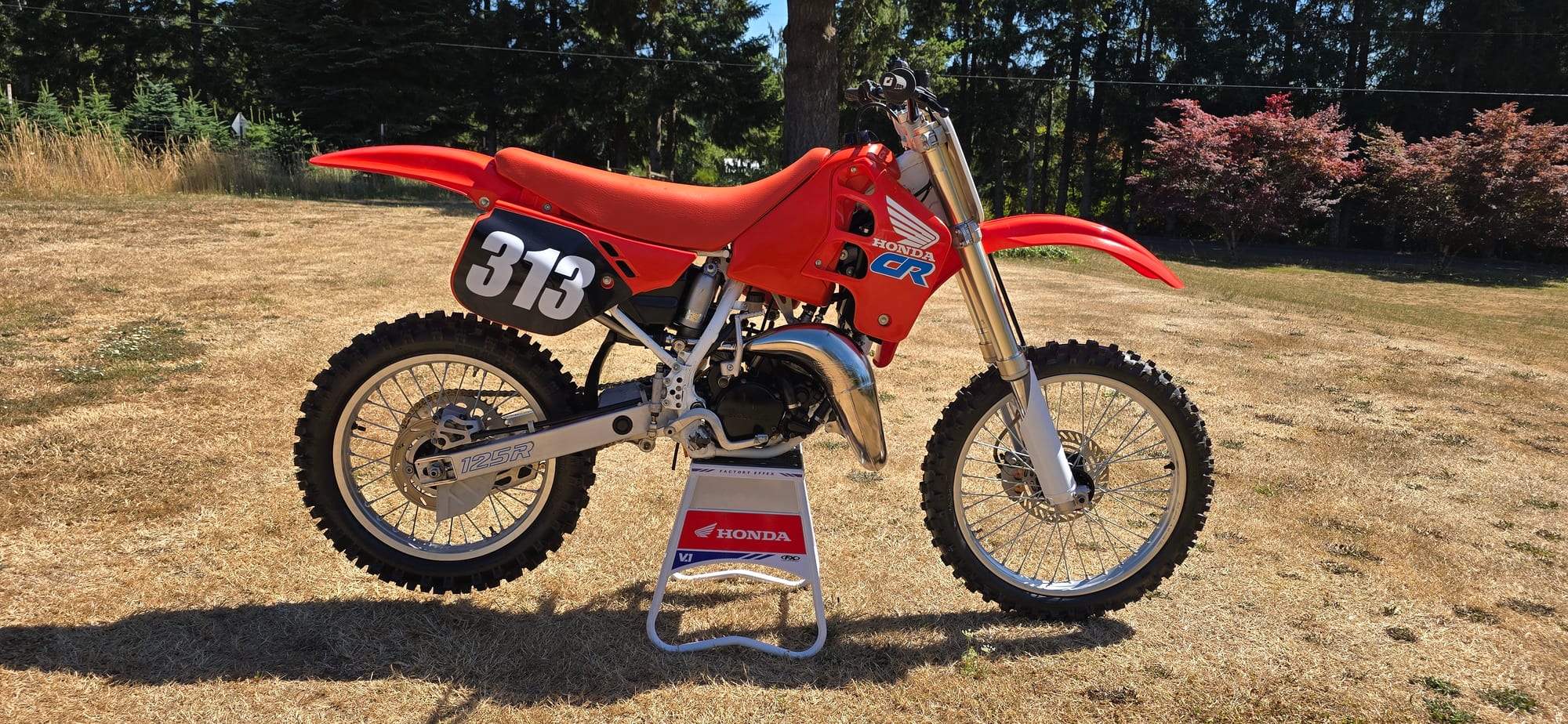
The '89 was the last CR125 with conventional forks and the old ATAC power valve. For 1990 Honda brought over the CR250R's HPP power valve and put inverted forks on the 125 for the first time. A year later the '91 got a new frame, CR250-style bodywork, and a reworked fork, so the 1990 stands alone: new engine and fork, original look. And the engine was a keeper: Honda kept it in the CR125, refined but never replaced, for at least the next decade.
1989
The end of an era- ATAC power valve, used on the CR125 since 1984
- 43mm Showa conventional forks, the last right-side-up CR125 fork
1990
This bike- First HPP power valve on a CR125, borrowed from the CR250R
- First inverted forks on a CR125: 45mm Showa
- Larger steering stem for a stiffer front end
1991
The fix-up year- New frame, with the engine set lower
- Reworked 45mm Showa fork and a new Kayaba shock
- Bodywork from the 1990 CR250R and the era's loud graphics
Engine
125cc two-stroke single
Honda Power Port (HPP) — first year on CR125
Pro-oriented; strong top-end with improved mid-range via HPP
6-speed
Bulletproof — virtually trouble-free
Chassis & Handling
Simple split steel cradle
Revised geometry and a larger-diameter steering stem — stiffer front end
Pinpoint steering response; light and flickable in the air
Suspension
45mm Showa inverted (USD) — first generation on CR125
Undersprung with mid-stroke harshness; requires frequent oil changes
Showa — similar characteristics to front
Brakes & Reliability
Single disc, front & rear — powerful with excellent feel
Completely trouble-free
Virtually indestructible with proper maintenance